
Queens political candidates and their lawyers appeared in Queens Supreme Court on Thursday regarding their petitions to get on the ballot in this year’s elections. Eagle photo by Ryan Schwach 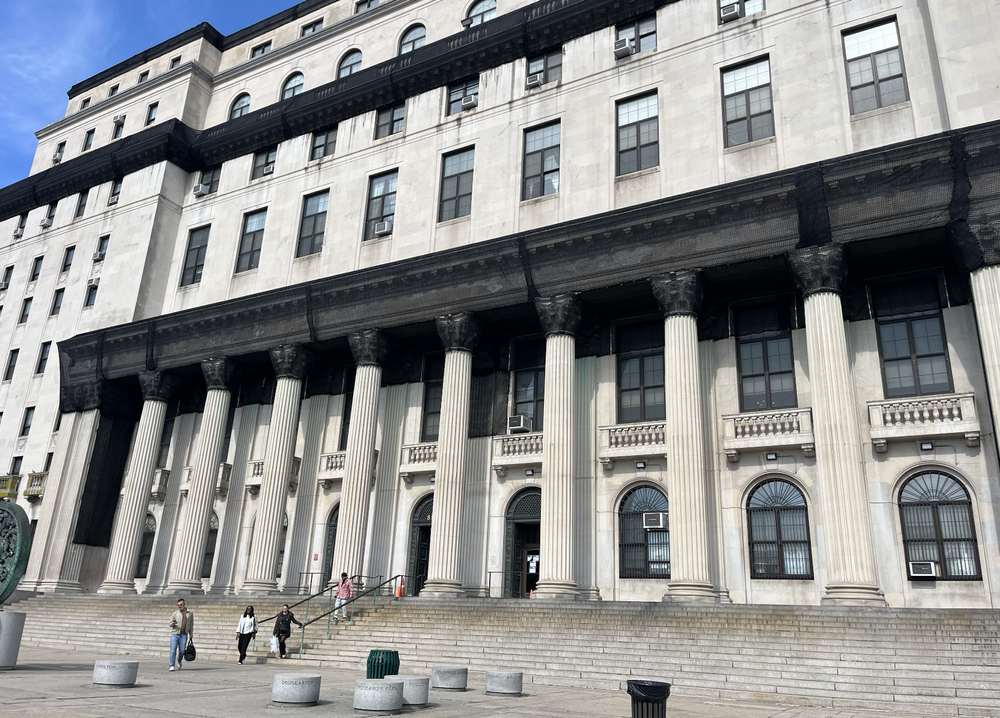
By Ryan Schwach
Queens judges on Thursday heard allegations of fraud, the use of AI in court filings and objections to thousands upon thousands of signatures on ballot petitions from Queens voters.
The marathon of court cases began as local political candidates and their election attorneys ventured to Queens Supreme Court in Jamaica for their first appearances to accuse their opponents or defend against accusations that their petitions to get on the ballot in this year’s elections don’t stand up to legal muster.
Nearly 30 cases were heard, mostly by Queens Supreme Court Justice Tracy Catapano-Fox, from candidates looking to kick their rivals off, or keep their own name on voter’s ballots in June’s primary and November’s general election.
One of the more notable cases of this year’s petition season involves Democratic Socialists of America-backed Assembly candidate David Orkin, who accused his opponent, incumbent Assemblymember Jenifer Rajkumar, of submitting petitions with fraudulent signatures.
Rajkumar has denied the allegations and her attorneys have argued the case is meritless.
The case, as well as most of the others, were adjourned until April 30, after the Board of Elections makes their own determinations on signatures at the beginning of next week.
Court cases involving election petitions are generally straightforward. Election lawyers, of which there are only a handful in New York City, file cases against their client’s opponents with a throw it at the wall, and see what sticks sort of an approach.
The objections filed against a candidate’s petitions are often broad and mundane. For instance, abbreviating street as “St.” or Avenue as “Ave.,” are grounds for a petition to be thrown out.
In some situations, the cases rise to a higher level, like the one involving Orkin and Rajkumar.
Orkin is accusing Rajkumar’s campaign of forging signatures on her campaign petitions.
He alleges that her campaign forged the signatures of several Queens locals, including the signatures of a prominent DSA member, one of Orkin’s old roommates, a voter who was in Colorado on the date they allegedly signed the petition and another DSA member who was in Montreal.
The socialist’s campaign claims that they can invalidate enough petitions to kick Rajkumar off the ballot.
At court on Thursday, the case was transferred to Judge Denise Johnson. Both parties agreed to adjourn the lawsuit until next Thursday.
Orkin was present for the beginning of the day, and Rajkumar was represented by Gerard Sweeney and Frank Bolz of powerhouse Democratic law firm Sweeney, Reich and Bolz.
Also present during the court appearance were the seven petition witnesses mentioned in Orkin’s lawsuit, who were subpoenaed by Orkin’s lawyer.
They all appeared to be teenagers, and declined to speak to reporters.
Candidates begin to drop
Democratic lawyers successfully kicked progressive candidate Andrew Engel off the ballot in the 11th Senate District, where he was challenging longtime incumbent Toby Ann Stavisky.
Engel previously conceded that he didn’t have enough petitions to appear on the ballot, and did not appear in court on Thursday.
Petition challenges also knocked Democrat Electra Holmes off the ballot in the 23rd Assembly District.
Holmes conceded in person on Thursday.
The only other definitive decision came involving Robert Speranza, a Republican candidate who conceded to being kicked off the Conservative ballot line in the race for Assembly District 26. He remains on the Republican ballot.
An AI candidate
Several other cases were either adjourned to next week, or assigned to another judge to hear the deeper arguments.
Catapano-Fox retained a case involving one of Queens’ more notorious Queens political figures, Jonathan David Rinaldi.
Rinaldi, who is known for his AI-laden campaigning and prolific sperm donation habits, is seeking to invalidate Hevesi’s candidacy on the Democratic Party line.
The Republican-turned-Democrat’s argument centers on what happened after Hevesi’s own party affiliation was switched without his knowledge from Democrat to Working Families Party.
Hevesi has accused Rinaldi of forging documents to the BOE claiming to be the assemblymember, which Rinaldi has denied.
Rinaldi is arguing that when the Queens Democratic Party issued a document approving Hevesi to run as a Democrat, they broke election law because he was, at the time, already a Democrat.
Hevesi’s attorneys from Sweeney, Reich and Bolz don’t see any sense or merit in Rinaldi’s argument.
Sweeney and Bolz also told the Eagle they believe Rinaldi, who has used AI to create campaign videos of himself and fake videos of his opponents and fictitious supporters, used AI in the court case.
“If you read the cases…some of them have false citations,” Sweeney told the Eagle.
Rinaldi denied the allegations.
Queens voters will have a better idea of who will survive ballot objections and stay on the ballot next week, when the BOE makes decisions about general objections made to the petitions.
The agency has hearings scheduled for April 28, 29 and 30.
